Ordered Map library in C++
CompletedNovember 20, 2023
A C++ ordered map implementation designed to power an LRU Cache simulation.
Technologies Used
Overview
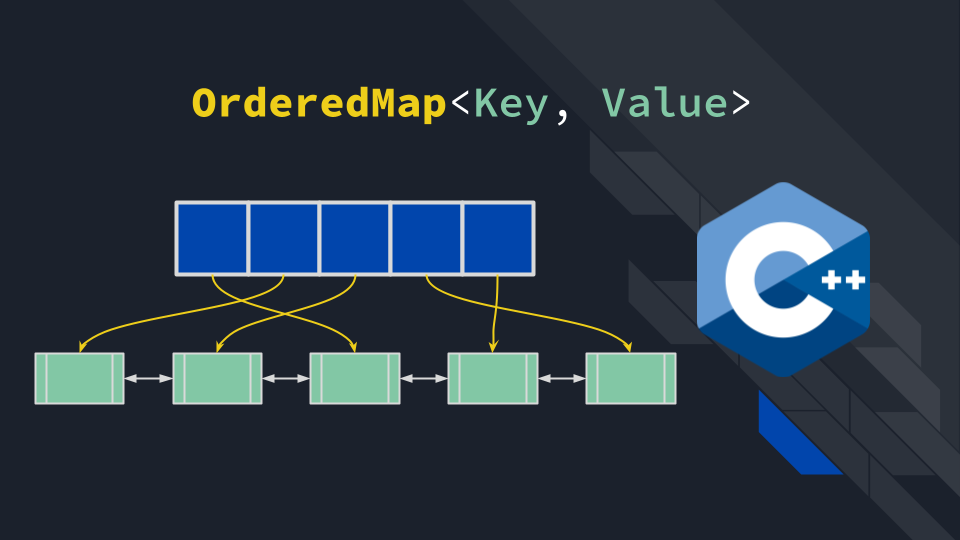
I developed this library to efficiently simulate a Least Recently Used (LRU) Cache, addressing a fundamental limitation of standard C++ maps. While std::map and std::unordered_map offer fast lookups, they cannot natively track element usage history or maintain insertion order. This project implements a custom data structure that combines the speed of a hash map with the ordering capabilities of a linked list, delivering constant-time access and sequence management—critical requirements for cache eviction policies. I implemented the DoublyLinkedList from scratch instead of wrapping std::list to have full control over memory management and iterator semantics, demonstrating deep understanding of smart pointers and low-level pointer manipulation.
Key Features
- LRU-Ready Architecture: Designed to support "move-to-front" operations essential for tracking recently used items.
- O(1) Average Complexity: Ensures that both lookups and position updates (reordering) occur in constant time.
- STL-Compatible Interface: Mimics standard library APIs (e.g.,
find,insert) while strictly enforcing the order of elements.
Technical Challenge & Solution
The Challenge: The core difficulty was implementing the "promote on access" behavior required for an LRU cache without degrading performance. In a naive implementation, moving an accessed element to the front of the queue would involve removing and re-inserting the data, which triggers expensive memory allocation and deallocation. I needed a way to reorder elements dynamically while ensuring all operations remained strictly O(1).
The Solution: I engineered a composite structure using a Hash Map pointing to nodes in a custom Doubly Linked List.
- Pointer Manipulation: Instead of moving data values, I implemented a
splice-like operation that unlinks a node from its current position and relinks it to the list head by strictly updating pointers. - Iterator Stability: The Hash Map stores persistent iterators to the list nodes, allowing me to "teleport" to any node and move it instantly without searching the list or invalidating the map's references.
Future Improvements
- Thread Safety: Adding mutex locks to support concurrent cache access in multi-threaded environments.
- Custom Allocators: Implementing a memory pool to further reduce the overhead of creating new list nodes during high-volume insertions.